Beyond championship-level racing, 1935 featured a wide range of competitive motorsport across the United States and internationally. In the U.S., dirt-track racing dominated regional competition, with hundreds of events held at fairgrounds, county tracks, and local ovals. Drivers piloted sprint cars, big cars, and modified machines, often competing outside formal sanctioning, keeping motorsport active and popular during the Great Depression.
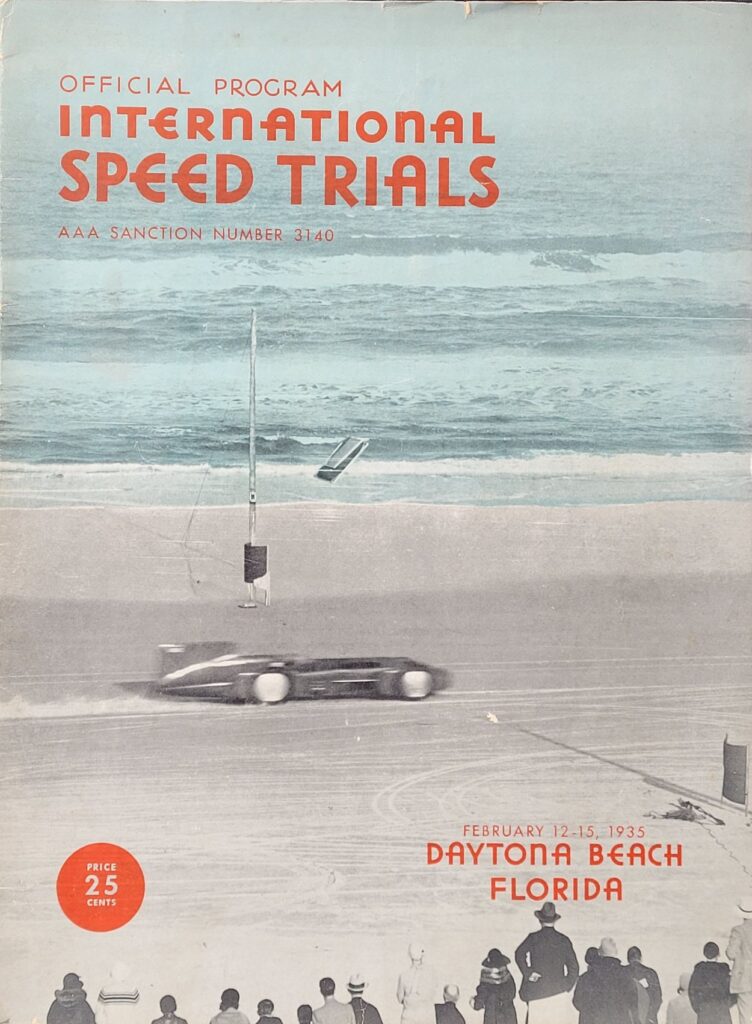
Land speed racing remained a major attraction. The 1935 Daytona Speed Trials marked the final world record attempts on the sands of Daytona Beach, highlighted by Sir Malcolm Campbell’s two-way average of 276.82 mph in the Blue Bird. Later that year, Campbell moved to the Bonneville Salt Flats, where he became the first person to exceed 300 mph, permanently shifting high-speed record attempts to a safer, more reliable surface. These events drew international attention and showcased rapid technological advances in engines, aerodynamics, and tires.
Together, these competitions illustrate a diverse and transitional era in motorsport. Dirt-track and independent racing kept local interest strong, while land speed events at Daytona and Bonneville pushed the limits of performance, setting the stage for the postwar growth of organized stock-car racing and continued innovation in automotive engineering.